

FAQ: Can I wash pesticides off fruit and vegetables?
FAQ: Can I wash pesticides off fruit and vegetables?
Washing or soaking fresh fruit and vegetables, including organic produce, is important.
Here’s why you should:
The World Health Organisation advises that consumers can “limit their intake of pesticide residues by peeling or washing fruit and vegetables, which also reduces other foodborne hazards such as harmful bacteria.”
Leading international Parkinson’s Disease expert and neurologist, Dr Ray Dorsey, recommends washing fruit and vegetables, including organic produce, as one of his “Parkinson’s 25” actions to reduce exposure to pesticides and reduce the risk of Parkinson’s disease.
The Environmental Working Group in the USA have released a guide to washing fresh fruit and vegetables, which you can find here.
But here’s where it gets complicated.
Many modern pesticides are actually designed to withstand washing. Why? Pesticides are not cheap. If it rains the next day or next week, the pesticides run off into the rivers, waterways, adjoining properties etc and the growers may need to purchase more chemicals and reapply.
This is why many of the modern pesticides are PFAS or forever pesticides – they are designed to withstand rain, irrigation and time, and continue their effect for months. Many also now move inside the plant.
On top of this, in many cases these pesticides are also designed to be used in conjunction with specific patented seeds. The rise of pesticide use and farmer dependency is closely intertwined with the rise of genetically modified (GM) crops, particularly those engineered to tolerate specific herbicides.
Want to get technical? Keep reading.
Imagine spending thousands of dollars spraying a crop, only for the next rain shower to wash everything away.
That would be a disaster for Australian farmers, who are already on historically thin margins due to mounting corporate concentration, financial uncertainty and climate pressures.
Many modern pesticides are therefore formulated to spread evenly across leaves and fruit and bind tightly to the plant’s naturally waxy surface. Many remain effective for days or even weeks despite rainfall, irrigation and sunlight.
Some pesticides behave almost like a waterproof coating.
So while washing can remove some loosely attached residues, it often removes only a small proportion of pesticides that have bonded to the plant surface.
Then, you’ve got the fact that some pesticides don’t stay on the outside of the plant at all.
Modern pesticides generally fall into three broad categories (with some overlaps):
1. CONTACT
STAY ON THE OUTSIDE
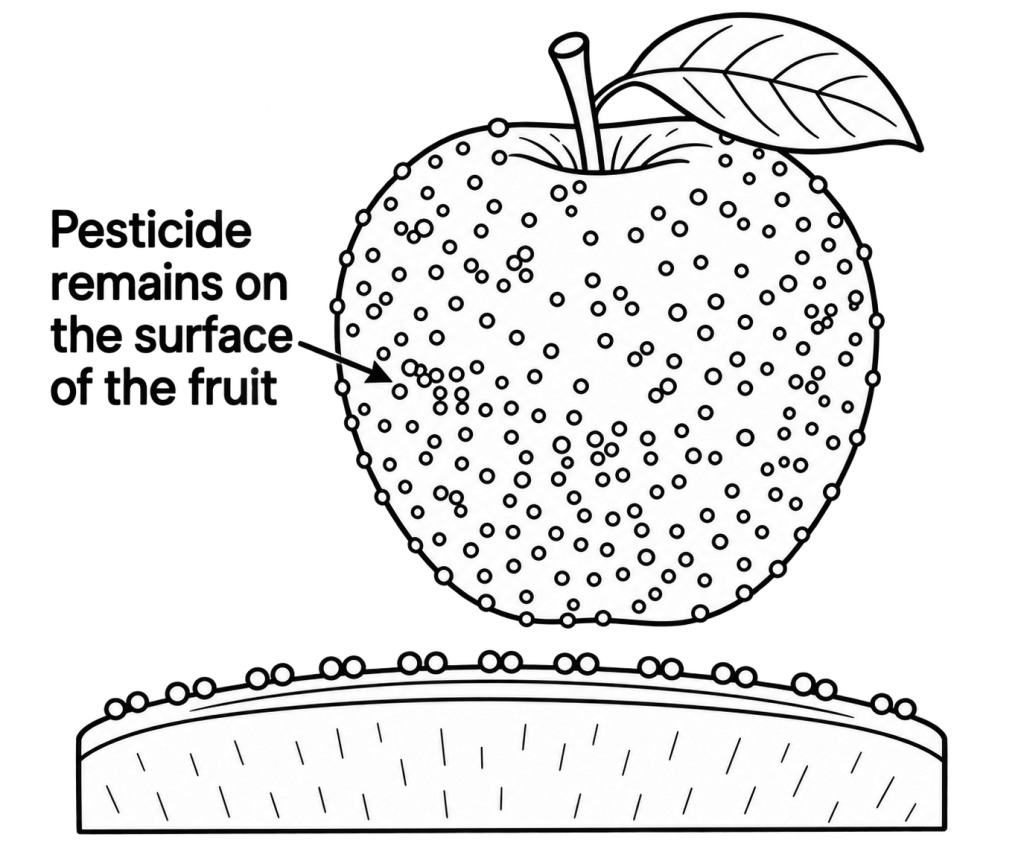
Examples: Bifenthrin, Chlorpyrifos, Permethrin, Fipronil, Malathion
2. TRANSLAMINAR
PENETRATE INTO OUTER LAYERS

Examples: Abamectin, Trifloxystrobin, Isocycloseram, Pydiflumetofen, Flubendiamide
3. SYSTEMIC
MOVE THROUGHOUT THE PLANT

Examples: Imidacloprid, Clothianidin, Spirotetramat, Acephate, Sulfoxaflor, Flupyradifurone
Contact pesticides in more detail
These remain on the outside of leaves and fruit.
They kill insects that are directly sprayed or that later crawl or feed on the treated surface.
Although they stay on the outside, many are highly residual (meaning they can stick around for a very long time) and bind strongly to the waxy cuticle of plants, making them surprisingly difficult to wash away.
A good example is bifenthrin, a synthetic pyrethroid insecticide that is highly residual and is commonly used in tomatoes, capsicum and blueberry crops. Although it remains on the outside of the plant/fruit, it binds strongly to waxy surfaces, meaning washing may remove some residues but cannot reliably remove all of the chemical.
Translaminar pesticides in more detail
These move beyond the surface and penetrate into the outer tissues of leaves and fruit.
Once absorbed, they cannot simply be rinsed away because they are no longer sitting on the surface. Peeling may remove some of these residues, but not all. Many modern insecticides and fungicides (including several PFAS chemicals) work this way. The products move into the outer tissues of fruit and leaves, where they continue protecting the crop from pests and fungal diseases even after rainfall.
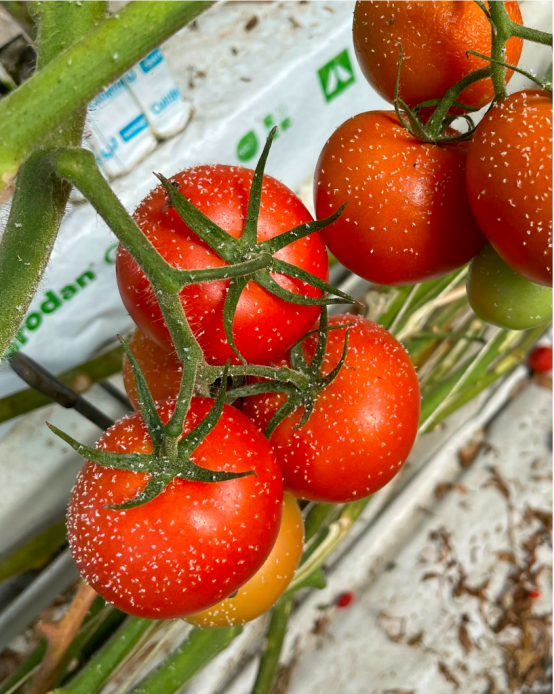
Example: Isocycloseram on berries
A recent example is isocycloseram, a newer insecticide now approved for use in many vegetable and fruit crops including berries. Isocycloseram is a PFAS pesticide with translaminar activity, meaning it can move into plant tissues rather than remaining only on the surface. This helps it provide longer-lasting pest control, but it also means residues cannot simply be washed away before consumption.
Systemic pesticides in more detail
Systemic pesticides go a step further.
After being absorbed through leaves, roots, seeds or seedlings, they move through the plant’s vascular system, becoming distributed throughout stems, leaves and developing fruit.
Because these pesticides are inside the plant tissue itself, washing cannot remove them.
One of the best-known examples is imidacloprid, a systemic neonicotinoid insecticide.
Example: Imidacloprid in lettuce
In Australia, imidacloprid is registered as a seedling drench in lettuce. Rather than spraying mature lettuce plants, growers treat young seedlings before transplanting. The roots absorb the insecticide, which is then transported throughout the growing plant.
By the time that lettuce reaches your supermarket, it may never have been sprayed directly – yet residues can still be present inside the leaves because the pesticide became part of the plant as it grew.
No amount of washing can remove pesticide that is already inside the lettuce.
Systemic insecticides are also widely used in many other crops. Active ingredients such as clothianidin (another Neonicotinoid), spirotetramat, cyantraniliprole, sulfoxaflor and acephate (organophosphate) are designed to move within plants so they can protect new growth and control insects feeding deep inside leaves or stems.
Example: Clothianidin in grapes
Clothianidin is another systemic neonicotinoid insecticide. Whilst it is not allowed to be sprayed on fruiting plants, it still can be applied before flowering to control pests, but because it is absorbed and transported through the plant, residues may still be present in the harvested grapes. The bunch may never have been directly sprayed, but the pesticide has moved inside the plant.
Pesticides aren’t always sprayed
Many people imagine pesticides being sprayed directly onto fruit. In reality, spraying is only one application method. Some pesticides are applied as soil drenches, where the chemical is absorbed through the roots. Others are delivered through drip irrigation (chemigation), allowing the plant to take up the pesticide without the fruit ever being sprayed directly.
For example, many vegetable and berry crops receive systemic insecticides through irrigation water. The pesticide enters through the roots, moves through the plant’s vascular system and protects new leaves, flowers and developing fruit from the inside out.
Seeds or young seedlings may also be treated before planting. The lettuce example is one of the clearest demonstrations of this process. Because the pesticide enters through the roots early in the plant’s life, residues may still be present in the harvested leaves months later.
In some tree crops – and even in bananas – systemic insecticides can also be injected directly into the trunk or pseudostem, bypassing the plant surface altogether.

Why farmers use these products
None of this is accidental. Growers want pesticides that continue protecting crops after rain, reduce the number of spray applications needed and reach insects feeding inside leaves or hidden beneath foliage.
Systemic products are especially valuable because they protect new growth and are less affected by weather. These characteristics improve pest control, but they also mean residues can remain within the harvested crop.
How long they persist depends on the active ingredient, the crop and environmental conditions. Some break down within days, while others remain active for weeks or months, with some breakdown products even lasting for years.
Does peeling help?
Peeling can reduce residues of many contact pesticides because they are concentrated on the outer surface.
However, peeling is less effective against translaminar pesticides that have penetrated beneath the skin and cannot remove systemic pesticides inside the fruit. It also removes valuable nutrients, fibre and antioxidants that are concentrated in the skin of many fruits and vegetables.
So… does washing remove pesticides?
Yes – but only to a point. Washing is worthwhile because it removes dirt, microorganisms and some surface residues.
However, many modern pesticides are intentionally designed either to adhere strongly to plant surfaces or to move inside the plant itself. For those pesticides, washing has only a limited effect.
In other words, the question isn’t whether your washing technique is good enough. There’s only so much you can do. It’s that many modern pesticides were specifically designed to survive washing in the first place.
Thanks for reading, and if you like this please donate to Pesticide Action Australia and get involved.