

Impact on Health
Exposure to pesticides is linked with serious, long-term health issues.
Pesticide exposure is linked with multiple serious, long-term health issues, including different types of cancers in adults and children, Parkinson’s Disease, birth defects, fertility decline, endocrine disruption, autoimmune diseases, Autism Spectrum Disorder, allergies, gut health conditions and more.
Cancer
Australia has the highest rates of:
Cancer incidence rates are expected to continue to rise in Australia.
The rise in incidence of cancers affecting young people in Australia is under the spotlight, with the ABC’s July 2025 Four Corners episode, Generation Cancer, covering this topic and highlighting chemicals applied into our environment as a contributing factor.
A recent study finds exposure to multiple pesticides significantly increases the risk of childhood cancers compared with exposures to just one pesticide.
Peer-reviewed journal Frontiers in Cancer Control and Society published research in 2024 titled ‘Comprehensive assessment of pesticide use patterns and increased cancer risk’, which said ‘our findings demonstrated an association between pesticide use and increased incidence of leukemia; non-Hodgkin’s lymphoma; bladder, colon, lung, and pancreatic cancer; and all cancers combined that are comparable to smoking for some cancer types.’
“In our study, we found that for some cancers, the effect of agricultural pesticide usage is comparable in magnitude to the effect of smoking,” said the study’s senior author, Dr Isain Zapata, Associate Professor at the Rocky Vista University, College of Osteopathic Medicine in Colorado.
In June 2025, the findings from the Global Glyphosate Study were published in Environmental Health journal. The study confirms that glyphosate and glyphosate-based herbicides cause various cancers, even at exposure levels considered ‘safe’ by regulators. Coordinated by the Ramazzini Institute in Italy, the study involved scientists from the US, South America, UK and Europe.
Australia has multiple cases of cancer clusters where communities are confident they are linked with pesticide exposure.
Despite the above, Australian cancer bodies (Cancer Council Australia, Leukaemia Foundation, Breast Cancer Research and Advocacy bodies, Lymphoma Australia and others) are not advocating on this issue.
‘Megan Varlow, director of cancer control policy at Cancer Council Australia, says they are “not aware of strong evidence” to suggest environmental factors may increase cancer risk.‘ – Sydney Morning Herald, November 2024
‘On the weight of available evidence, the Leukaemia Foundation considers glyphosate is safe for use provided the label directions are met.‘ – Leukaemia Foundation’s position paper on glyphosate
Call to Action
At Pesticide Action Australia we are advocating towards cancer bodies in Australia who have been silent around the evidence linking pesticides and cancer, unlike their international counterparts. We call on them to adopt the precautionary principle, and publicly accept and name pesticides as a risk factor of cancer.
Below is research and advice from expert international organisations regarding the evidence linking pesticides and cancer.
Breast Cancer
Breast Cancer UK
NZ Breast Cancer Foundation
Silent Spring Institute
Breast Cancer Prevention Partners
Australian and New Zealand Journal of Public Health
Leukaemia
Ireland Cancer Society
Canadian Cancer Society
Canadian Cancer Society
Childhood Cancer & Leukemia International Consortium
Global Glyphosate Study
Prostate Cancer
Stanford University
International Journal of Cancer
Bowel or Colorectal Cancer
International Journal of Cancer
Non-Hodgkin Lymphoma
International Agency for Research on Cancer
Irish Cancer Society
National Library of Medicine Journal
National Library of Medicine Journal
Parkinson’s Disease
Parkinson’s Disease is the fastest growing neurological disorder in the world.
Parkinson’s Disease incidence rates in Australia are increasing by 4% per year, impacting individuals and families all around country, and are estimated to impact our economy and healthcare systems at a cost of over $10 billion each year.
Parkinson’s Australia, alongside Parkinson’s Disease organisations around the world, are speaking out about the links between pesticide exposure and PD.
Research by UCLA Health and Harvard has found 53 pesticides implicated in Parkinson’s Disease, with 10 of these pesticides found to be directly toxic to dopaminergic neurons.
Parkinson’s Disease prevalence in Australia is projected to increase.
Below is research and advice regarding the evidence linking pesticides and Parkinson’s Disease.
Parkinson’s Disease
ABC Radio Australia
DW Documentary
Parkinson’s Europe
Parkinson’s Ireland
Michael J Fox Foundation
Australia’s top neurologists call for chemical regulator to ban paraquat herbicide over links with Parkinson’s disease
ABC News Australia
Medical News Today
Movement Disorders Journal
Endocrine Disruption
Endocrine-disrupting chemicals (EDCs) are chemicals that interfere with the natural hormones in our body, leading to a range of adverse health effects in humans and wildlife.
Many hazardous pesticides contain EDCs, and as such disrupt and damage our hormone system.
We are all now exposed to EDCs everywhere we go; exposure occurs through contaminated food and water, air, consumer products, and transfer from parents to offspring.
EDCs are associated with reproductive disorders, developmental abnormalities, hormonal imbalances, metabolic disorders, and increased risk of certain cancers.
Below is research and advice of the harm caused by pesticides containing EDCs.
Endocrine Disruption
Reproduction and Fertility Journal
Endocrine Society
Pesticide Action Network Europe
Pesticide Action Network Europe
Reproductive Health
Pesticides harm fertility, and pose serious risks to pregnant women and their foetuses.
More information can be found at YourFertility.org.au regarding Chemicals in our Environment, as well as in this video – Common chemicals used in the house and garden can affect your chances of having a baby.
Please also read this guidance from the US Center for Disease Control and Prevention (CDC) regarding the reproductive health impacts of pesticides.
If you are pregnant, or trying to conceive, please avoid exposure to all forms of pesticides and EDCs.
Please read this advice to keep you and your baby safe, or if you are planning to have children: How to avoid chemicals that can reduce fertility
1 in 6 couples in Australia and New Zealand suffer infertility. 1 in 6 people globally are affected by infertility, according to the WHO.
Below is research and advice regarding the evidence linking pesticides with reproductive disorders.
Reproductive Health
Reproduction and Fertility Journal
Antioxidants Journal
Harvard University – School of Public Health
ABC News Australia
Human Reproduction Update
Melbourne University
Nature Reviews Endocrinology
American College of Obstetricians and Gynecologists
Materials Today: Proceedings
Autism Spectrum Disorder
The number of Australians diagnosed with Autism Spectrum Disorder has increased significantly, and continues to increase.
Australia has one of the highest prevalence rates of autism in the world.
Growing research suggests a connection between pesticides exposure during early life and the development of Autism Spectrum Disorder and attention-deficit/hyperactivity disorder (ADHD). According to one peer reviewed journal, ‘there is a strong association between exposure to certain pesticides, like organophosphates, organochlorines, and pyrethroids, with autism spectrum disorder (ASD), ADHD, and impairments in cognitive function.’
Below is expert research linking pesticide exposure with autism.
Autism Spectrum Disorder
Neuroscience Journal
Impact of Glyphosate on Our Health – YouTube video with Stephanie Seneff
The Empowering Neurologist
International Journal of Environmental Research and Public Health
Capital Integrative Health
Gut Health
Growing evidence suggests that the human gut microbiota are being disrupted due to exposure to pesticides.
Industry and pro-industry voices have long-cited the absence of the shikimate pathway in humans as a reason why glyphosate is safe. It has now been demonstrated the shikimate metabolic pathway is present in many microbes in the human gut. One study demonstrated that more than one-half of human microbiome are intrinsically sensitive to glyphosate.
Below is expert research linking pesticide exposure with diminished gut health.
Gut Health
National Library of Medicine Journal
Frontiers in Microbiology
ScienceDaily
Environmental Toxicology and Pharmacology
Mental Health
Growing evidence is demonstrating the use of pesticides is closely related to adverse effects on human mental health, such as anxiety and depression.
Exposure to agricultural pesticides puts farmers at a six times greater risk of exhibiting depressive symptoms, including chronic anxiety, irritability, restlessness, and sadness. Specifically, exposure to organochlorines and fumigants (gaseous pesticides) heighten an individual’s risk of depression by 90% and 80%, respectively.
Individuals suffering from occupational pesticide exposure face a disproportionate risk of developing depression. However, pesticide exposure from nearby agricultural fields remains a threat to residential (non-occupational) human health. Previous studies found that populations living near farms are more likely to have high depressive symptoms. Similarly, a 2019 study found that teens and adolescents living in agricultural areas, where organophosphate exposure is prevalent, are at higher risk of depression.
Pesticide poisoning as a means of suicide
Beyond contributing to mental health decline, more than 100,000 people die yearly from intentional (self-harm) poisoning with pesticides. Pesticide poisoning is one of the most common methods of suicide worldwide, responsible for at least 14 million deaths since the 1960s.
The main reasons for this are how easily accessible and lethal they are when consumed. Research from the Pesticide Suicide Prevention Centre at Edinburgh University shows that in Sri Lanka, following bans of acutely toxic pesticides, there were enormous declines in suicides in the country (see graph below). Not only was government action to reduce the availability of lethal pesticides was highly effective in preventing deaths from pesticide self-poisoning, but importantly people weren’t substituting pesticide self-poisoning with other lethal methods of suicide, as it was the overall suicide rate (not just pesticide suicides) that fell. People were still self-harming with pesticides, but crucially, were no longer dying.
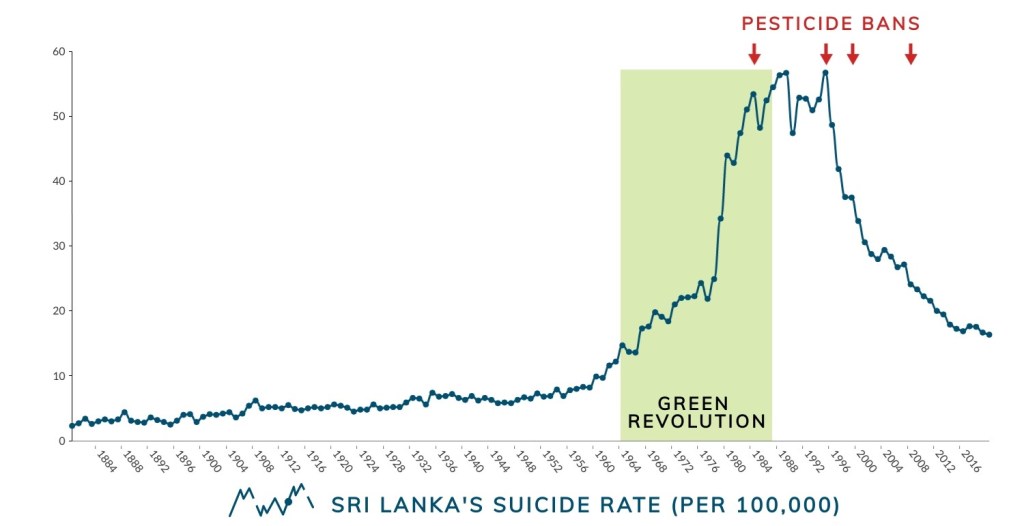
Below is expert research linking pesticide exposure with mental health disorders.
Mental Health
Rural and Remote Health International Journal
Environmental Science and Pollution Research
Asthma & Allergies
As of 2022, just under 2.8 million (10.8% of population, or 1 in 9) Australians had asthma.
Asthma was the leading cause of disease burden in 2023 for kids aged 1-14.
Exposure to pesticides increases the risk of developing or exacerbating asthma and other allergies, especially in children and adolescents.
Asthma Australia has no mention of the link between asthma and pesticides. Asthma Canada have released guidance, see below.
Below is expert research linking pesticide exposure with asthms and allergies.
Asthma and Allergies
Asthma Society of Canada
National Library of Medicine
Motor Neurone Disease
There is growing evidence that exposure to pesticides is linked with Motor Neurone Disease.
In the past 30 years, the number of deaths caused by MND had risen by more than 250% in Australia.
Below is expert research linking pesticide exposure with MND.
Motor Neurone Disease
Occupational & Environmental Medicine
Birth Defects
A birth defect is a problem that develops while a foetus is in the womb during pregnancy. Maternal and paternal exposure to toxic agrochemicals have been associated with greater chances of children being born with congenital malformations.
Birth defects are also referred to as congenital anomalies, congenital malformations, congenital abnormalities or congenital disorders. Although little is still known about the origins of many of these disorders, they are largely due to complex gene-environment (epigenetic) interactions.
Recently the importance of the environment as one of the major reproductive risk factors has been strengthened, and pregnant women and developing foetuses are particularly vulnerable.
Birth defects have a very high social, emotional and economic cost, so preventing them should be an absolute priority for public health.
Below is expert research linking pesticide exposure with birth defects.
Birth Defects
The American Academy of Pediatrics
Dr Laura Riali, European Confederation of Primary Care Paediatricians
Dr. Paul Winchester, Medical Director of the Neonatal Intensive Care Unit at Franciscan Health Hospital, Indianapolis.
Pesticide Action and Agroecology Network
National Library of Medicine
Acknowledgement of Country
We acknowledge Aboriginal and Torres Strait Islander peoples as the original custodians of the land, and respect the rights that they hold as traditional custodians. We also recognise the dispossession of the land and its ongoing effects on First Nations Peoples today. Sovereignty was never ceded.

Pesticide Action Australia (ABN: 33 681 669 670) is an ACNC registered charity. We are currently seeking endorsement as a Deductible Gift Recipient, and if approved donations of $2 or more to PAA will be tax deductible in Australia. As we are newly-established, our DGR status is currently still pending.
 Pesticide Action Australia