
Filter results

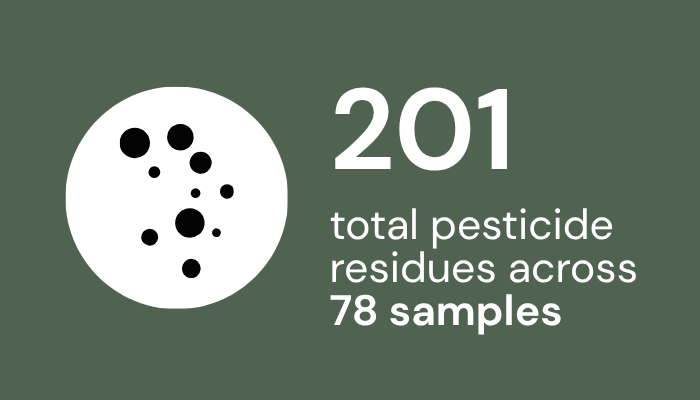
We sent 78 samples of 13 different types of fruit and veg bought from Aldi, Coles and Woolworths stores around the country for pesticide residue testing.
Here’s what was found.
We purchased a total of 78 samples of 13 types of fruit and vegetables from Aldi, Coles and Woolworths stores across five cities (Adelaide, Brisbane, Sydney, Perth and Melbourne) in June 2026. Produce was bought in store and delivered to a NATA-accredited laboratory on the day of purchase.
This report is a snapshot. With 78 samples, the percentages in this report describe what was found in these samples. They are not national averages. While we call on supermarkets and the Australian Government to increase the transparency and efficacy of their own residue testing schemes, we will continue to undertake testing of produce to keep consumers informed.
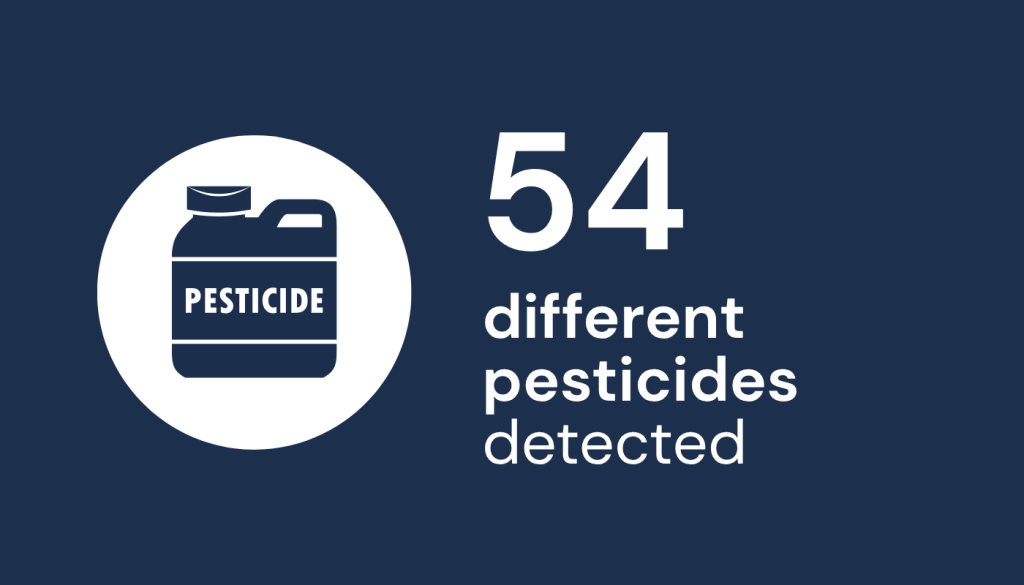


Pesticides – chemicals that are designed to kill pests. They include a wide range of compounds including herbicides (for weeds), insecticides (for insects), fungicides (for fungi like mould and mildew), rodenticides (for rats and mice) and others. They are mainly used in the growing of agricultural crops, but are also used in our towns, cities, homes and gardens.
Residue – a trace of pesticide remaining on produce.
MRL (Maximum Residue Limit) – the maximum amount of a specific pesticide residue permitted on a specific crop.
Not approved in the EU – a pesticide that is not approved for use in the European Union, often on health or environmental grounds. Actives and approvals searchable on this EU Pesticides Database.
Organisation for Economic Co-operation and Development (OECD) – The Organisation for Economic Co-operation and Development (OECD) is an intergovernmental economic organisation of 38 member countries, mostly high-income economies, including Australia.
Per- and polyfluoroalkyl substances)(PFAS) – The most widely-accepted definition of PFAS has been developed by the OECD. As per the OECD definition , PFAS are substances containing at least one fully fluorinated methyl (–CF₃) or methylene (–CF₂–) carbon atom, without any hydrogen, chlorine, bromine, or iodine attached to it. This definition is also used in Australia’s PFAS National Environmental Management Plan 3.1.
PFAS pesticides aka Forever Pesticides
Many newer pesticides meet the internationally-agreed definition of PFAS. Pesticides containing PFAS are a significant and growing source of environmental and health harm to Australia.
Per- and polyfluoroalkyl substances (PFAS) are known as ‘forever chemicals’ because of their extreme persistence in the environment, where they damage ecosystems, waterways, wildlife, soil microbiota and reproduction. They are also linked with a range of human health issues including cancers, high cholesterol and immune system dysfunction.
Isocycloseram on berries
Australia’s industry-funded regulator has increased the use of forever chemical, isocycloseram, on Australian berries.

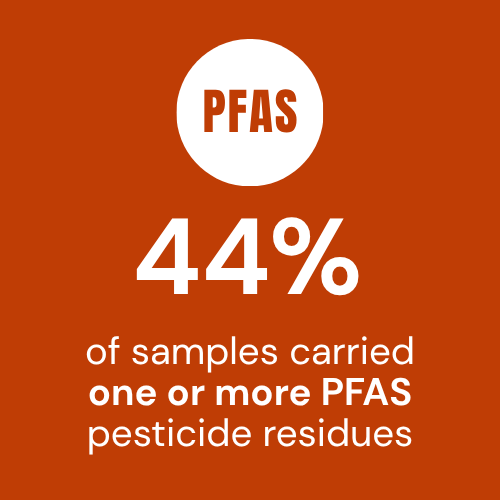
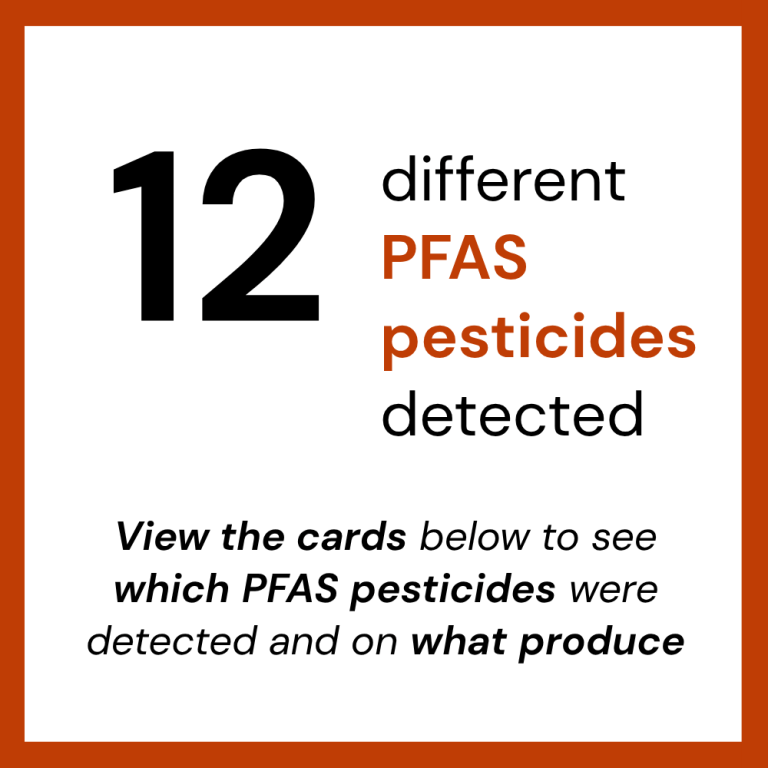
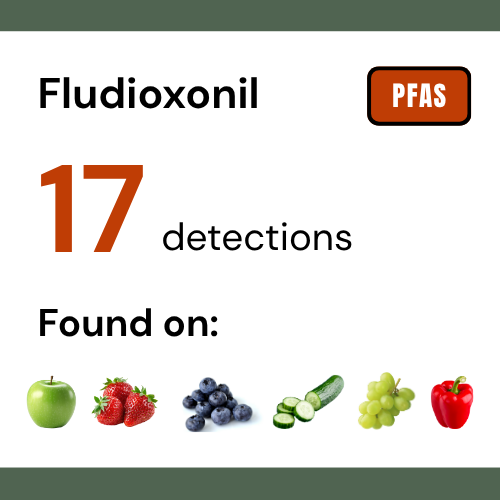
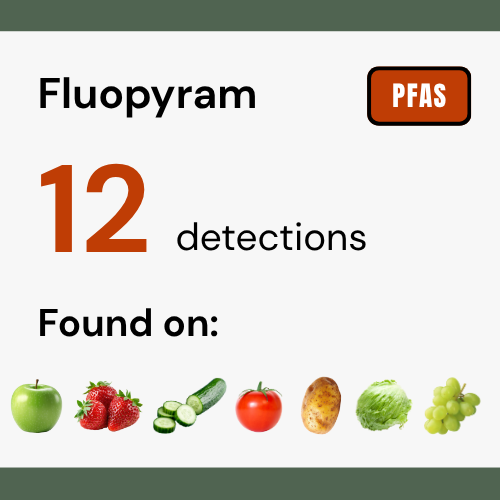
Residues of PFAS pesticides were detected across the samples tested. Here’s what was found.
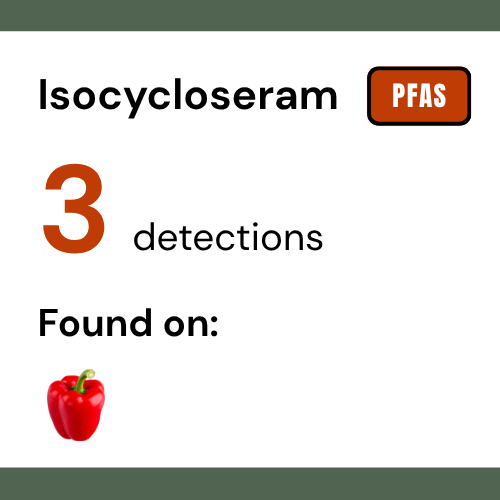
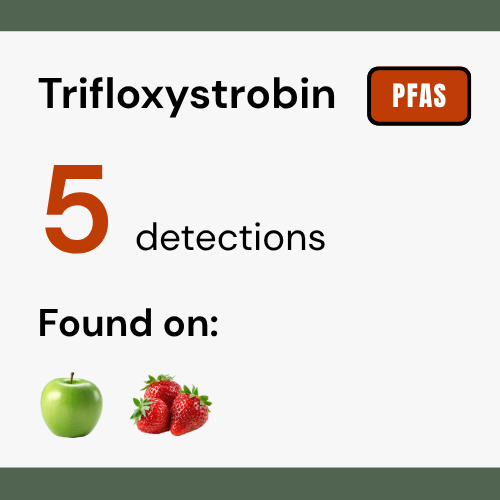

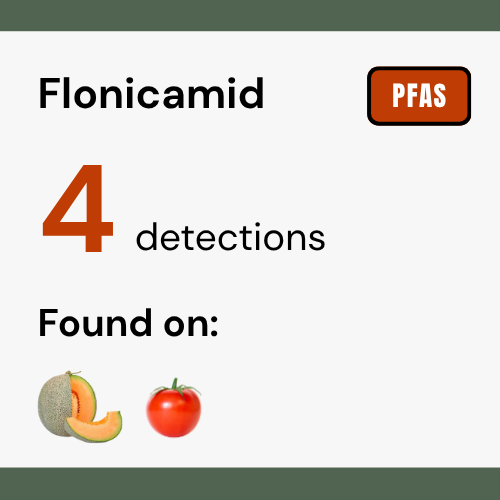
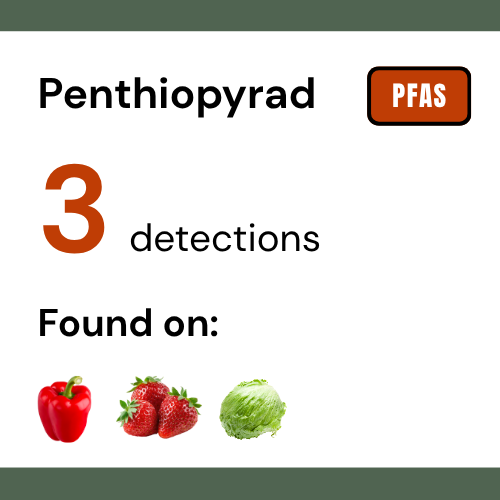


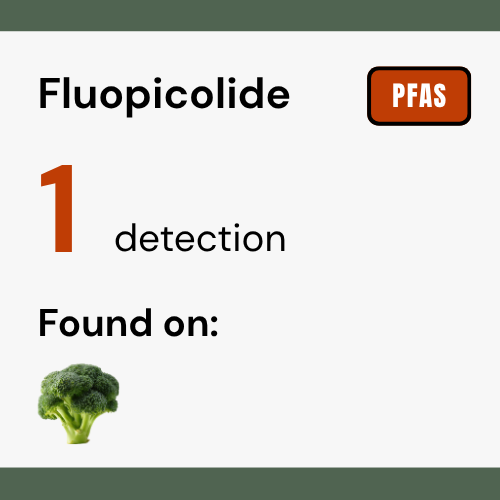
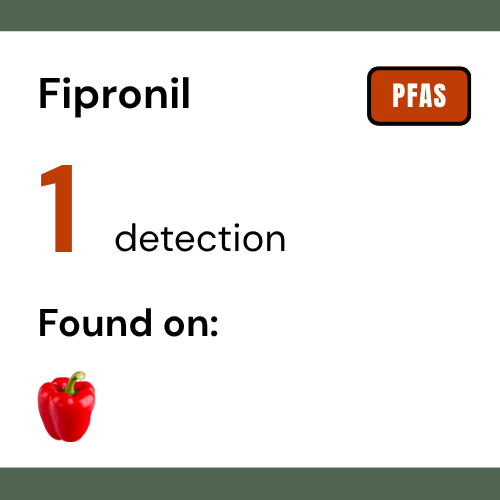

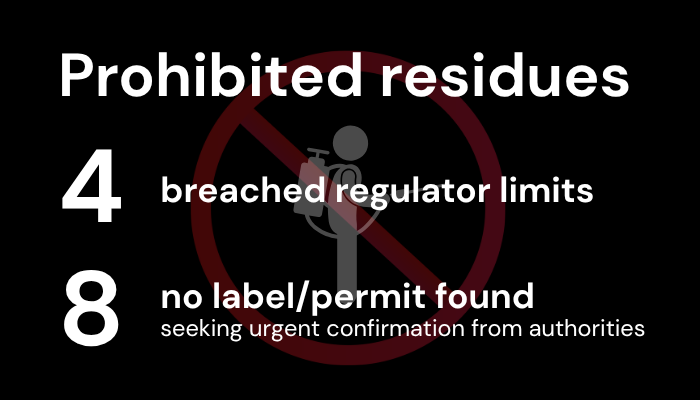
Prohibited residues were detected across the samples.
Multiple detections of prohibited residues, from a relatively small sample size, highlight the real-world impact of irregular, inadequate Government testing schemes and opaque supermarket testing protocols. More on this below.
Woolworths, Aldi and Coles each have their own protocols for residue monitoring, testing and grower accountability. These protocols and testing results, unlike those of supermarkets in other countries, are not made available to the Australian public.
Australia’s National Residue Survey is an industry-funded and industry-led residue testing scheme. Residue testing of grains, fruit, vegetables or non-exporting animal products is voluntary. In the last 5 years, the only fresh fruit and vegetables to have been volunteered for testing have been apples and pears.
The Australian Total Diet Study is Australia’s ‘most comprehensive monitoring survey of chemicals, nutrients and other substances in the Australian diet.’ There have been 6 surveys conducted in the last 20 years. Each survey tests different produce types for different contaminants – rendering comparison of data also not possible. As an example of the scope, the last study conducted in 2021 screened for 30 PFAS compounds across 112 food items. These compounds relate predominantly to PFAS contamination from firefighting foam and industrial pollution. No PFAS pesticide was tested for.
In fact, the last Total Diet Study to focus on agricultural chemicals in our food was published in 2019 – but the samples for that study were actually collected in 2013-2014. So, the latest national pesticide data from the ATDS comes from food bought more than a decade ago.
Meanwhile, our industry-funded pesticide regulator approves hundreds of new pesticide products onto the Australian market every year.
Compare this with international standards like in the UK and US where governments undertake annual pesticide residue testing of thousands of samples and publish results as regularly as every quarter. The UK and US programs are oriented toward consumer dietary safety and public reassurance. Australia’s National Residue Survey is heavily oriented toward trade and market access – verifying “good agricultural practice” so producers can market “clean and green” produce. Note that even these more rigorous consumer-oriented testing schemes overseas are criticised for not being transparent enough.
So, what is a prohibited residue?
Pursuant to relevant State and Federal legislation, a prohibited residue is a residue of a pesticide that breaches the Maximum Residue Limit or a residue of a pesticide that is not registered for use on that crop (i.e. use on that crop is not permitted on the label or via a permit).
Breaches of Maximum Residue Limits
What are Maximum Residue Limits (MRLs)?
Off-label/permit uses
Growers must use only pesticides which are registered for the respective crops (as stated on the chemical label) or via a special permit for the crop in question. The pesticide also needs to be correctly applied by the growers at the rate and timing specified on the label/permit, which also helps to ensure that the residue on the produce stays below the APVMA’s Maximum Residue Limit (MRL).
Prohibited residue results
Not approved in Europe
60% of Australia’s high-use pesticides are banned in the European Union. Many of those banned pesticides are linked to Parkinson’s Disease, cancers, water contamination, endocrine disruption, collapse of bee colonies, biodiversity loss and neurological harm in children.
According to Pesticide Action Network, as of December 2024, Australia had banned 24 hazardous pesticides, the EU/UK had banned 225 hazardous pesticides, nearly 10 times more.
A key reason why Australian regulation lags behind countries around the world is because our pesticides regulator is nearly entirely funded by industry (88% industry-funded in 2024-2025). This is a serious conflict of interest and not the norm internationally.
Further to the industry-funding, the Australian Government uses a risk-based system, whereas EU and UK use a hazard-based system. See here for more. In short, the EU and UK treat pesticides as inherently hazardous, whereas Australia treats pesticides as something to be risk-managed.
“The continued use of pesticides banned overseas places Australia increasingly out of step with leading international chemical policy reform and may complicate trade, particularly given that more than 70 per cent of Australia’s primary produce, worth nearly $80 billion annually, is exported.”
Professor Susan Bengtson Nash
Environmental Toxicology at Griffith University
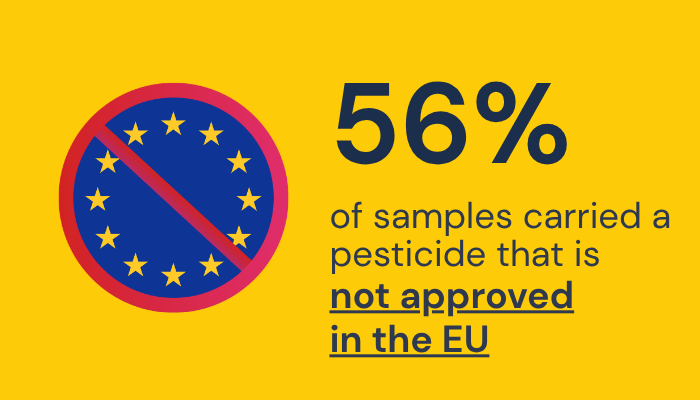
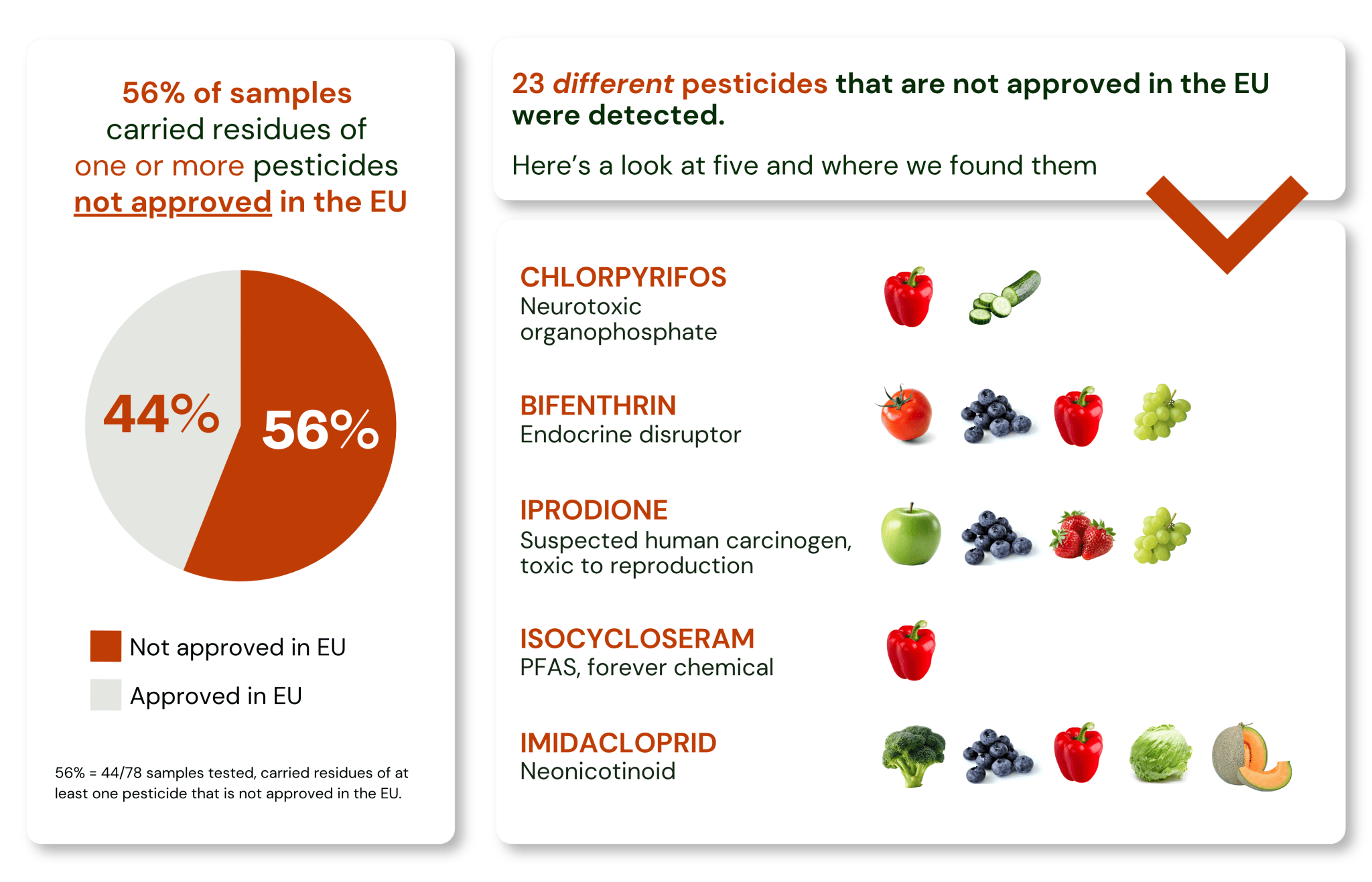
Residues of pesticides that are not approved in the EU were detected across the samples tested. Here’s what was found.
Pesticide Action Australia analysed the results using EU Pesticides Database.
Organophosphates
For many Australian children, food is the single most significant route of pesticide exposure. Organophosphates (OPs) are a group of pesticides known to be particularly toxic to humans, and especially children.
Biomonitoring studies in high-income countries show up to 90% of children have detectable pesticides in their bodies, with dietary exposure identified as a major pathway.
Underestimated and overlooked: The silent impact of pesticides on children
UNICEF report, 2026
In its 2026 report, Underestimated and Overlooked, UNICEF singles out organophosphate insecticides as a particular threat to children, describing the developing brain and nervous system as direct targets of these chemicals.
UNICEF says the evidence associating OPs with reduced cognitive and motor performance is ‘substantial‘, with exposure in utero and during early childhood linked to poorer cognitive, behavioural and social development.
The American Academy of Pediatrics (AAP) has also expressed their deep concern about OPs, and linked early-life exposure to organophosphate insecticides with reductions in IQ, cancer, and abnormal behaviours associated with attention-deficit/hyperactivity disorder and autism. See here for AAP’s policy paper on pesticides.
The dangers of OPs have long been known and established. As a result, the UK and EU removed the majority of OPs from use.

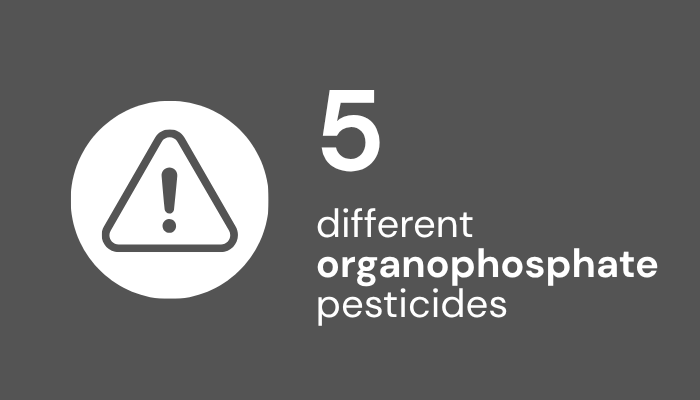
11 detections of 5 different organophosphate pesticides were found on samples tested. Here’s what was found.
Dimethoate
Possible human carcinogen
Banned in 38 countries*
Banned in UK and EU over concerns that long-term dietary exposure could harm consumers.
Found on:

Chlorpyrifos
Found on:



Malathion
Probable human carcinogen
Banned in 40 countries*
Can damage DNA and disrupt hormones. Linked to non-Hodgkin lymphoma and prostate cancer.
Found on:

*PAN International Consolidated List of Banned Pesticides, Dec 2024
Neonicotinoids (aka neonics)
Neonicotinoids are what’s known as systemic pesticides. They are taken up by the plant and transported to all its tissues, leaves, flowers, roots, stems, as well as pollen and nectar.
They are extremely toxic to Australia’s native pollinators and any insect that feeds on the produce. Even small amounts can impair bees’ ability to forage, navigate, and reproduce.
Research also links neonicotinoids with declines in bird populations and contamination of waterways.
These chemicals persist in the environment, and as such their impacts extend far beyond the fields where they are applied. They are widely banned in the EU and UK.
In 2018, Australian retailers like Woolworths, and Coles followed Bunnings and Mitre 10 to ban the sale of neonicotinoid pesticides from their stores – but supermarkets continue to sell them as residues in our food and in flea treatments for our pets. See the link for more on the harm caused to pets, humans and the environment by pesticides in veterinary medicines.
Aldi has a pollinator policy in the USA and encourages suppliers to limit use of non-essential pesticides and transition away from neonicotinoids, glyphosate and chlorpyrifos. There is no such policy for Australia.
As of September 2026, there are 495 neonicotinoid products being sold on the market in Australia.

11 residues of neonicotinoid pesticides were detected across samples tested. Here’s what was found.
Imidacloprid
Banned in 29 countries*
Found on:

Clothianidin
Banned in 29 countries*
Found on:

*PAN International Consolidated List of Banned Pesticides, Dec 2024
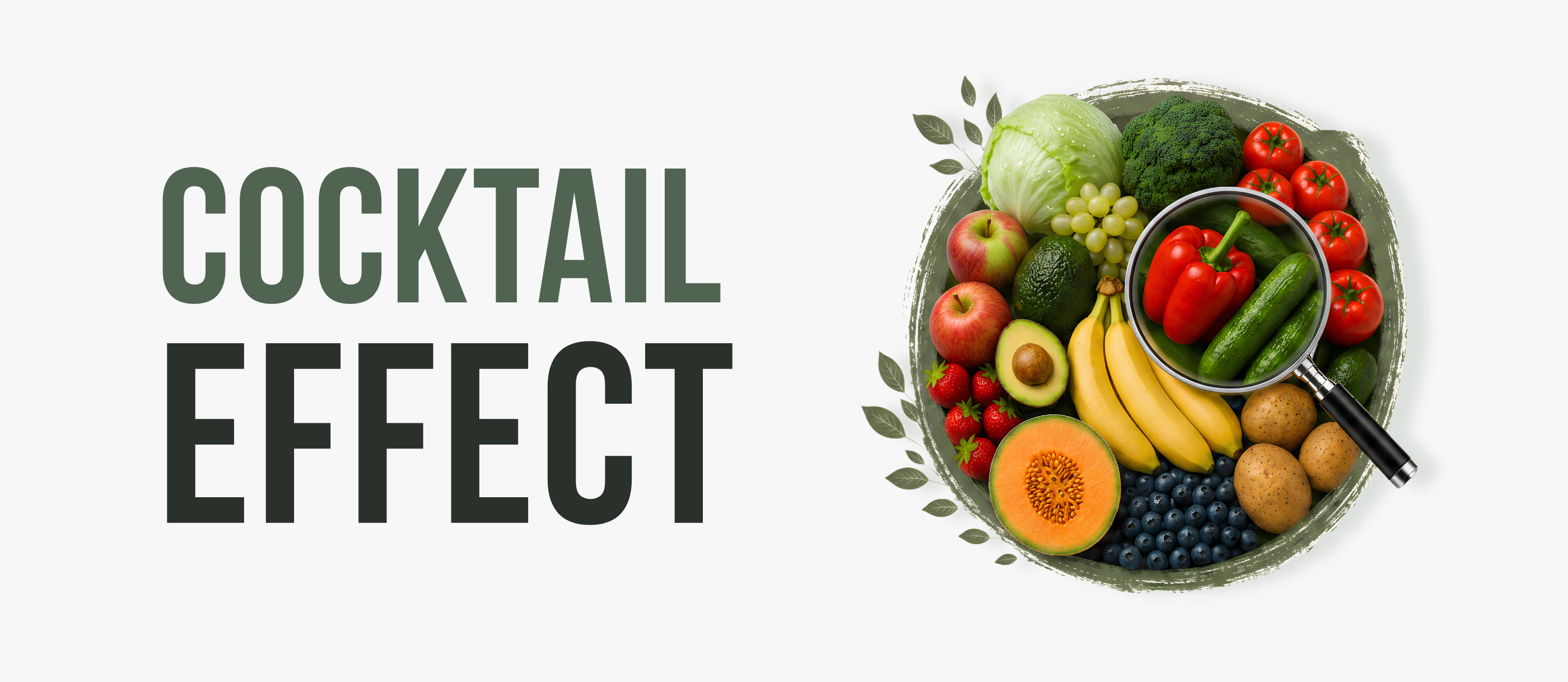
Growers often use several different pesticides, so a single piece of fruit or vegetable can end up carrying residues from more than one. This real-world combination of different pesticides on your food is known as the Cocktail Effect.
However, Australia’s industry-funded regulator, the APVMA, assesses and sets Maximum Residue Limits for pesticides in isolation, ignoring the chemical cocktail we actually consume.
What are Maximum Residue Limits (MRLs)?
“We know little to nothing about all the endless combinations of chemicals and how they can work synergistically or antagonistically to alter the safety and effects of individual chemicals. Greater attention needs to be focused on quantifying the collective exposure of consumers to not just single chemicals but the reality of the ‘chemical soup’ we consume on every fruit and vegetable.“
Associate Professor Mark Green
Reproductive Biology, University of Melbourne
A single piece of fruit, let alone a full meal, delivers chemicals in combination, and the combined effect is untested, despite evidence of increased toxicity in combination.
The same blind spot leaves our environment and wildlife exposed to the total, unmonitored chemical load.
“Our current regulatory models often fail to account for the cumulative impact of these chemical cocktails on children’s developing bodies. We must acknowledge that testing chemicals in isolation does not reflect the multi-chemical reality children face daily.“
Senior Adviser, UNICEF
See the full list of the pesticides detected
Filter by EU approval, and classes of pesticides such as PFAS, neonicotinoids or organophosphates. Hover over each pesticide in the dial to see the number of times it was detected and on what produce.
It’s time for change.

This report highlights a number of concerns about our fresh produce, and the pathway forward to healthier, more sustainably grown food.
Australian growers are ready to use fewer chemicals when supermarkets and government support them to do so.
Australian consumers are also ready.
In a September 2026 poll of over 1000 Australians, 80% of respondents said they want fewer pesticides on their fresh fruit and vegetables, even if it means they might find more insects or insect damage.
Online independent survey of 1,008 Australians, Sept 2026
As published by the World Bank, Australia now uses more than the world average of pesticides per hectare of cropland – roughly double that of the US, and triple that of China.
What we’re asking
We are inviting Australian supermarkets to take the lead and work collaboratively and transparently for measurable pesticide reduction. Pesticide reduction strategies should be promoted and rewarded by retailers, government, and consumers.
At the same time, industry self-regulation is usually a poor substitute for Government regulation, and this report demonstrates the regulatory failures occurring throughout the country.
We call on Government at all levels to provide real support to farmers to help them transition to nature-friendly farming practices, and reform Australia’s pesticide regulation in line with international best practice, to protect Australia’s health and environment.
What you can do
Send this letter to supermarket CEOs and government calling for more testing, greater transparency and real support for growers.
Just fill in your postcode, edit if you wish and press send. It takes less than 2 minutes.
A clear path forward
In the United Kingdom, major supermarkets have worked with growers, industry and civil society to implement pesticide policies that measurably reduce the chemical load on farms and in food.
As recently as 2019, no UK supermarket published its residue-testing results. In 2026, multiple do, and have effective pesticide reduction and pollinator policies.
It’s time Australian supermarkets did the same.
Australian farmers need our support.
Australian farmers are being squeezed from all sides. Facing growing pressures from climate change, extreme weather conditions, and rising production costs, our farmers are also caught in a supermarket squeeze.
Australia’s highly concentrated grocery sector gives supermarkets significant bargaining power over suppliers. So, while customers are paying more at the checkout, this isn’t going back to farmers and rural communities.
Many farmers want to reduce their pesticide use. We’re calling on government and supermarkets to support them, so they can do so without bearing all the risks and costs alone.
Hear from farmers:
“People are starting to ask what’s on their food, and rightly so.
Supermarkets need to be leading on reducing pesticides, they need reduction targets and policies, like they have overseas. Because no-one is policing and there are too many cowboys here.”
Australian grower who requested anonymity for concern about reprisals.
“I’d prefer to find a bug on produce any day rather than eat some of the stuff that’s been sprayed. We treat our crop as a precious ecosystem, but not every grower can afford to – there are so many pressures.“
Grower in South Australia who requested anonymity for concern about reprisals.
“I meet growers all the time who spray their crops every couple of days just because that’s what they’ve always done, even if they don’t have a pest problem. They often don’t realise how toxic the pesticide is and what they’re exposing themselves, the crop or consumers to.”
Agricultural scientist who requested anonymity for concern about reprisals.
Stay informed
Get the latest from Pesticide Action Australia.
Donate
Power our work and fund more testing.
Share
Help spread the word and make change.